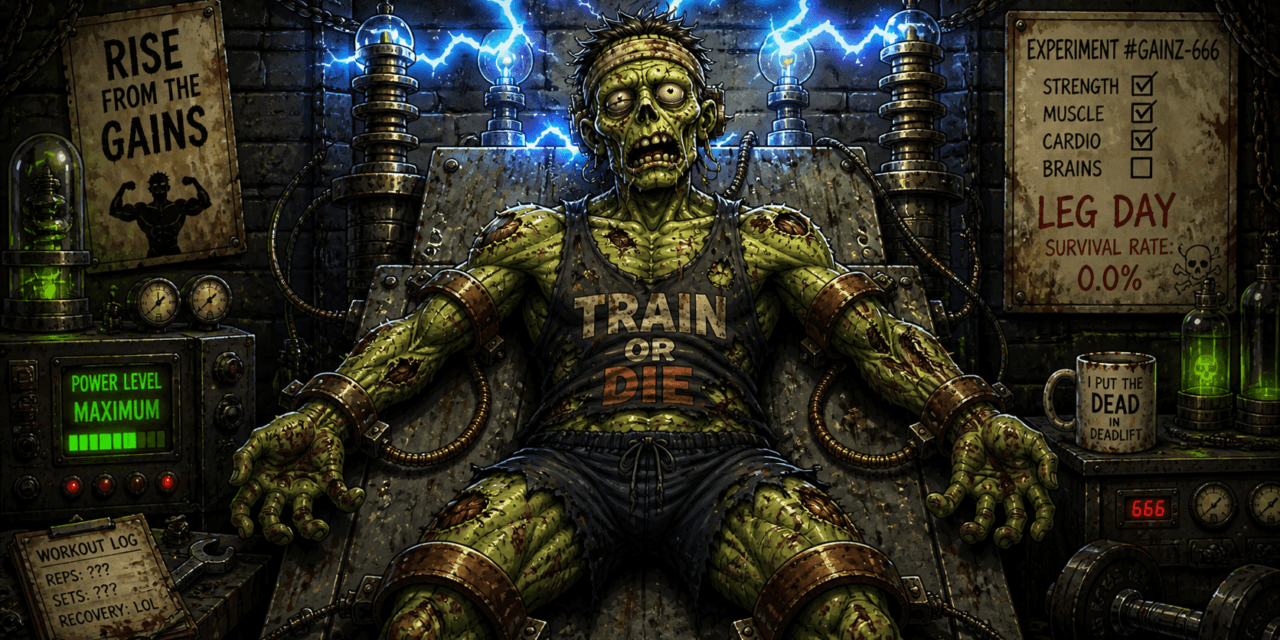
The testing continues, because apparently dragging this undead husk back toward the land of the living now requires a full electrical inspection. This time, the doctors sent me into the EMG chamber, which sounds like something from a bargain-bin Frankenstein sequel, but is actually an electromyography test paired with a nerve conduction study.
The nerve conduction study, or NCS, came first. That is the part where they stick electrodes on your skin, send small electrical pulses through the nerves, and measure how fast and how strongly the signals travel.
In normal human terms, it helps check how well the nerves are carrying messages to the muscles.
In Fitness Zombie terms, they hook up the corpse, flip the switch, watch the limbs twitch, and see which wires still spark.
And I have to admit something weird.
I kind of enjoyed that part.
The zaps made my hands, arms, legs, and feet twitch like the lab assistant had finally found the right lever. It felt strange, but not bad. Honestly, some of it felt good. Maybe that says something about me. Maybe after months of symptoms, stiffness, weakness, and body parts ignoring basic instructions, feeling anything fire correctly felt like a small undead celebration.
Then came the EMG.
That part was less charming.
The EMG uses tiny needles inserted into different muscles to measure electrical activity. I understand why it matters. I appreciate that it gives the doctors useful information. I respect the science.
I also did not enjoy it.
Some spots were not too bad. Other spots hurt like the doctor had found a hidden nerve goblin and decided to poke it directly in the attitude. The needles were temporary, but they were not subtle. The Fitness Zombie may be technically dead inside, but apparently several muscles still had strong opinions.
So, yes, the test checked the wiring.
The NCS was the fun Frankenstein zap session.
The EMG was the part where the monster regretted signing the consent form.
An EMG and NCS combo usually takes about 30 to 90 minutes and helps doctors look for nerve damage, muscle problems, and neuromuscular disorders.
In zombie terms, the test is looking for things like:
- Dead wires in the haunted house: nerve damage, pinched nerves, or signals that are not traveling the way they should.
- Muscles refusing to answer roll call: weakness, twitching, pain, or muscles that are not firing correctly.
- The “why is this body doing that?” category: numbness, tingling, unexplained pain, weakness, or mobility problems.
- The scary monster checklist: things like ALS, carpal tunnel syndrome, radiculopathy, muscular dystrophy, or muscle inflammation.
My doctor ordered EMG and NCS testing for both my upper and lower body. I have now completed both rounds, which means I have been professionally taped, zapped, poked, measured, and judged by machines.
So there’s that.
The Upper Body Test: A Small Win From the Crypt
I had minimal expectations from the upper body test.
The numbness in my finger had been annoying, but it was not the symptom keeping me from walking normally, mounting a dirt bike, or feeling like my left leg had been outsourced to a confused subcontractor.
Still, the upper body test gave me an answer right away.
Carpal tunnel syndrome in both arms.
That was not exactly party-hat news, but it was useful news. The numbness in my finger was tied directly to that, and the doctor prescribed braces for me to sleep in.
That counts as a win.
Not a “the zombie rises from the table and storms the village” kind of win, but a win. One symptom has a name. One problem has a likely treatment path. One mystery moved from the “what fresh nonsense is this?” pile into the “okay, now we do something about it” pile.
At this stage, I’ll take it.
The Lower Body Test: The Answer That Wasn’t
I had higher hopes for the lower body test.
That was the one I really wanted to explain things. The left leg weakness. The mobility problems. The exhausted, unsteady feeling. The part where my body acts like climbing onto a dirt bike requires a city permit and three emergency crews.
I wanted the test to point at something and say, “There. That’s the problem.”
No such luck.
The lower body EMG and NCS showed mild neuropathy in both legs, but nothing that explains what I’m actually feeling. At least, not from what I was told. The doctor said the findings were mild, not something I would likely notice, and certainly not enough to explain the bigger mobility issues.
So now I’m stuck in that frustrating middle ground.
There is a result, but it does not feel like the result.
There is an answer, but it does not answer the question I walked in with.
Or shuffled in with.
Let’s be honest, the Fitness Zombie does not exactly stride confidently these days.
My Doubts About the Test
I’ll be honest. I have doubts about how thorough the lower body testing was.
That does not mean I think the test was wrong. It means I still do not have a firm diagnosis that explains what I am actually feeling. I also do not fully understand how the test lines up with the spine issues already reported on the MRI, or whether the way the EMG and NCS were performed would capture the kind of nerve or mobility problems I’m dealing with.
So that is where I have to be careful. Doubts are not answers. They are just signs that I need to ask better questions.
That is what I plan to do when I meet with my primary care doctor. I need to turn the uncertainty into clear questions:
- How do the MRI findings connect to my symptoms?
- Did the lower body EMG and NCS test the right areas to explain the left leg weakness and mobility issues?
- Could the spine damage still be contributing even if the testing only showed mild neuropathy?
- What symptoms does the mild neuropathy explain, and what does it not explain?
- What should we investigate next?
That has become one of the bigger lessons in this whole mess. I do not need to pretend I know more than the doctors. I also do not need to sit quietly when something does not match what I am experiencing.
My job is to pay attention, ask better questions, and keep pushing for answers without turning into a WebMD goblin at 2:00 a.m.
Then the Conversation Got Heavier
After the EMG and NCS testing, I discussed my symptoms further with the doctor who conducted the tests.
He suggested the possibility of a previous brain injury or possibly a stroke.
That is not exactly the kind of sentence you want casually dropped into your day.
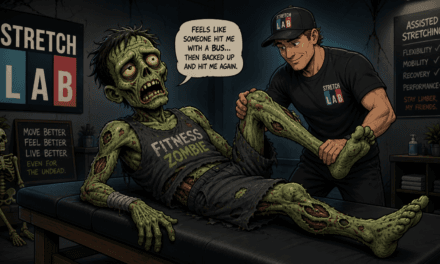
The stroke idea had crossed my mind before, but I had mentally moved away from it because of the positive results I have seen from the work at StretchLab. Some of my movement and mechanics have improved with focused stretching and bodywork, which made me think this was more mechanical than neurological.
But that does not rule anything out.
It just means this zombie still has more rooms to search in the haunted house.
In the end, the doctor requested a brain MRI, which was already next on my primary doctor’s list. He also recommended eight weeks of physical therapy.
So, more testing. More appointments. More work.
The glamorous fitness journey continues, now with extra medical imaging.
Where Things Stand
Right now, I’m sitting with a minor win and a bigger pile of questions.
The win is that the finger numbness has an explanation. Carpal tunnel syndrome in both arms is not thrilling, but it is something I can address. Sleep braces are not exactly a fashion statement, but neither is shambling around with numb fingers.
The questions are mostly around the lower body.
Why is my left leg still struggling?
Why does my mobility feel so limited?
Why do my legs feel exhausted and unsteady?
How do the MRI findings, EMG results, NCS results, and symptoms fit together?
And what does the brain MRI show, if anything?
That is the hard part right now. I have pieces, but not the full picture.
The Fitness Zombie Takeaway
This phase is frustrating because I am doing the right things and still not getting clean answers.
I went to the doctor. I explained the symptoms. I did the MRIs. I completed the EMG and NCS testing. I’m following up. I’m not ignoring it. I’m not pretending everything is fine while my body throws sparks and drags a leg behind me like an underfunded horror movie prop.
But progress does not always show up as one big answer.
Sometimes progress is one symptom explained.
Sometimes it is one bad theory removed.
Sometimes it is a referral to physical therapy.
Sometimes it is another scan.
Sometimes it is learning how to ask the next question.
So that is where I am.
One small win.
More questions.
More testing.
Eight weeks of physical therapy ahead.
The corpse is still moving, even if the wiring diagram remains deeply suspicious.
I'm on a lifelong quest to find the perfect balance between strawberry smoothies and pizza slices. A self-proclaimed gym enthusiast who believes rest days are just as crucial as leg days—especially if they involve NASCAR racing. I lift weights, but only so I can justify my love for chocolate cake. When I'm not at the gym, you’ll find me riding dirt bikes or capturing the thrill of motorsport through my camera lens. Join me as I navigate the highs and lows of fitness, where progress is measured in reps, and cheat meals are a form of self-care.
If you shuffle through my links and make a purchase, I might earn a commission—these are affiliate links and come at no extra cost to your living soul, just zombie perks to keep this corner of the internet undead and kicking!